Sunday, March 06, 2011

On payments

Ohad Sammet, writing for TechCrunch:

“We hear a lot of chatter about new payment services, and who’s competing in the space, and obviously who’ll win the space or own a big piece of it. Lately we’ve seen some movement when both Apple and Google announced new payment options for digital publishers and exchanged a few blows. So are the giants going to displace PayPal soon?”

The current chatter about new payment services is usually triggered by extrapolations of the promises of NFC technology that is getting built into newish mobile hardware. There's a lot of valid discussion that can be had about this topic, but Apple's (or Google's) recent announcements of their terms for subscriptions have very little to do with it.


The subscription services launched by Apple and Google have to do with the cost structure of publishing content on their platforms, and what is the cut that is retained before paying the publishers. This is completely unrelated to the underlying payment infrastructure that is used to make these transactions.1

“The bottom line is that it is much harder to compete in payments using the same path PayPal took 10 years ago. Creating yet another network based on existing methods is a “me too” strategy that doesn’t provide real incentive for merchants to switch [...]. This is not real disruption. What is, then? I’m betting on two trends—payroll (becoming the wallet, getting people to keep their money with you) and short term credit (built from the ground up to be a robust system). This warrants a whole different discussion. Right now, however, it seems that Google and Apple are not going down those paths or presenting an alternative; and until they do so I believe they won’t be serious players in core payments.”

I don't see anything that would indicate that Google and Apple are not going down those paths, because as mentioned above, the subscription announcement have got nothing to do with this. (Neither do I see, by the way, anything that would indicate they are going down those paths, beyond rumors.)


What is clear however is that real disruption is exactly what is needed ; most of the complexities of payment systems today have to do with the existing cost structures and current infrastructure capabilities, and neither of these are immune to changes.


As Ohad mentions, using bank payments today has massive implications in terms of taking on risk for short-term credit. But in a connected world, I struggle to see any technological reason why a transaction between a payer and payee cannot be instantiated, validated and confirmed in a matter of seconds. This would eliminate the need for any payment processor to take on that short term credit risk.


And credit card payments are saddled with overly complex cost structures and terms, which — besides the fact that they are a golden goose for the likes of VISA and Mastercard — are obstacles to massive-scale acceptance as a peer-to-peer payment system — even with the beautiful work of companies like Square. The fees for merchants are variable depending on the terms of their contracts, on the physical presence of the card (swipe) and they are a confusing combination of both fixed costs (percentage of transaction) and variable costs (flat fee) ; although here again, Square must be applauded for taking this on and doing away with the confusing flat fee.


These constraints are based on antiquated systems and therefore heightened risk, and there is much potential for disruption here. There is also no reason whatsoever that a rectangular piece of plastic be required for effecting a payment. That is I think the last ball and chain of companies like Square, and while the ubiquity of the plastic card is what enables them to get the initial penetration and acceptance required for success, I also hope that they are already preparing for a future where these anachronistic artifacts are happily forgotten.


1. In Apple's case, the user pays 100% of the cost of the transaction using their iTunes account, which is backed by a credit card. Apple then distributes 70% of that to the publisher, usually via once-a-month bank transfers. None of that is changing.

Labels: , , , , , , ,

Monday, August 09, 2010

 Magic Trackpad + Keyboard

I'd like to see this. For a living-room setup (which is my case with my Mac Mini), it's a lot easier to handle one single item than two separate devices.

 Magic Trackpad + Keyboard [no.1]

 Magic Trackpad + Keyboard [no.2]

 Magic Trackpad + Keyboard [no.3]

Labels: , , ,

Friday, August 21, 2009

Ctrl-Alt-Delete on a mac keyboard

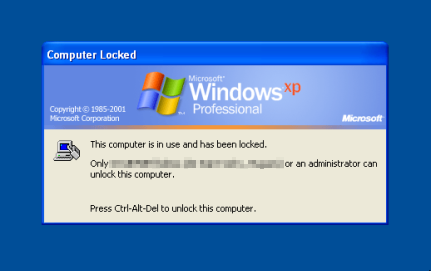
If you're trying to control a Windows system from a Mac computer, you might be wondering how to send the command Ctrl-Alt-Delete (control-alt-delete). It's often necessary to use this command, for example to unlock a session that was previously locked, as shown in the picture below:

locked Windows session

If you're running Windows on your Mac using Boot Camp, it's pretty simple: the Option key replaces the Alt key.
In some cases however, pressing the keys Control, Option (alt), and Delete on the keyboard of a Mac laptop does not have the desired effect. I ran into this issue today, and since it seems that many people are asking how to do this, I thought I'd post some answers:

VNC
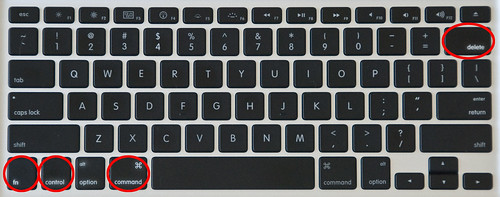
If you are using VNC to access another Windows machine, you should use the following keys: Fn + Ctrl + Cmd + Delete
(function-control-command-delete), as shown in the example picture below:

macbookpro_keyboard-1

Remote Desktop
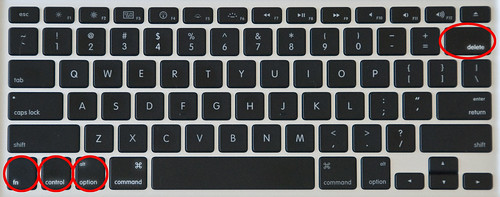
If you are using Microsoft's Remote Desktop Connection to access a windows (virtual) machine, you should use the following keys: Fn + Ctrl + Opt + Delete
(function-control-option-delete), also as shown in the picture below:

macbookpro_keyboard-2

I hope this helps.

Labels: , , , , , ,

Monday, February 18, 2008

About Apple's "locked strategy" for the iPhone

An article in today's New York Times chronicles the smuggling of iPhones across the planet, notably to China, where a large part of the "missing" phones are reported to be. The author explains that this "shows what happens when the world’s hottest consumer product defies a company’s attempt to slowly introduce it" and that the smuggling, while further proof of the iPhone's popularity, is a blow to Apple’s business model of exclusive partnership deals, similar to their partnership with AT&T in the United States.

To be sure, Apple is not getting as much money from unlocked phones, since they are not receiving any cut of the monthly subscription fees for those phones (reportedly a part of all of Apple's agreements with carriers in the US and in Europe to date). And it is also accurate that Apple is continuing to seek similar exclusive agreements in the new markets where it wants to offer the phone, and may be struggling to achieve those in China.

However, I feel that the article fails to mention an important reason behind Apple's initial marketing strategy: Apple offered exclusivity to US phone carriers such as AT&T and Verizon partly as a carrot, in order to ensure they had enough leverage to push through their Visual Voicemail feature. Visual Voicemail can require significant changes in the back-end operations of a cellular carrier's network, and is therefore not as attractive a feature to those carriers as it is to consumers. However, Apple believed strongly in changing the game for voicemail (thank god) and they promoted this feature right from the beginning, so they had to offer something in exchange for the carrier's efforts.

So while Apple could certainly choose to forgo its demands to share in the monthly subscriber revenues, the following quotes from analysts do not reflect the entire situation:
Some analysts say abandoning the locked phone system and allowing buyers to sign up with any carrier they choose, in any country, could spur sales.

“The model is threatened,” Mr. Wolf, the analyst, said. But “if they sold the phone unlocked with no exclusive carrier, demand could be much higher.”

From Apple's standpoint, "allowing buyers to sign up with any carrier" assumes that all carriers offer Visual Voicemail capability, and it would be tough to convince those carriers to spend the money for those network modifications without the promise of a large uptick in subscribers...

Labels: , , , , ,

Tuesday, April 10, 2007

Green my Apple

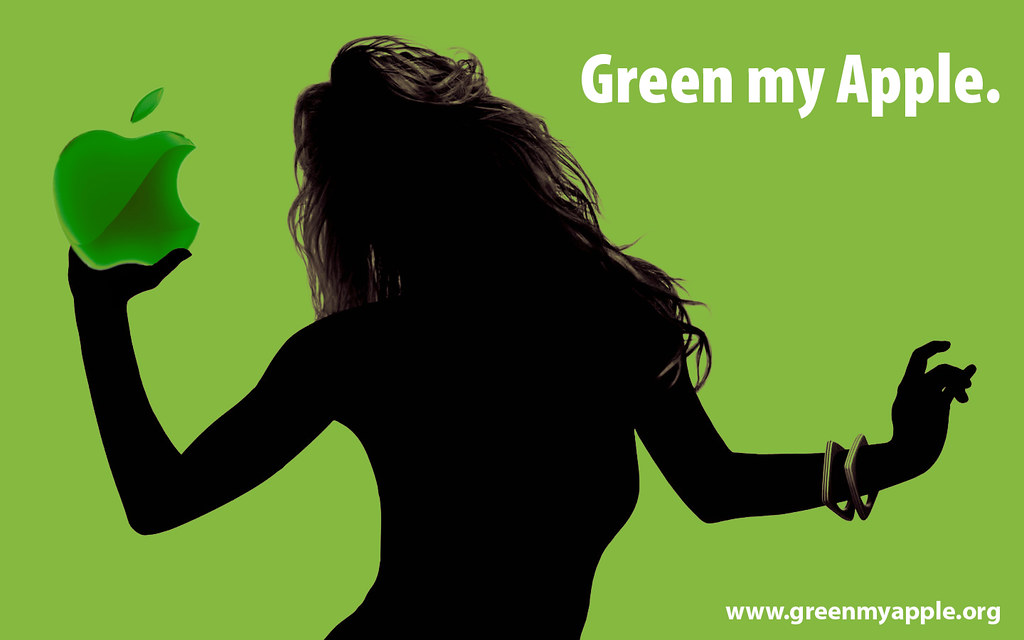
Here's a wallpaper (1440x900) that I put together to contribute to the "Green my Apple" campaign. This campaign by Greenpeace is designed to encourage Apple to be more conscious of their impact on our environment and modify their products and processes to reduce waste and toxic products. Find out more at: www.greenmyapple.org/

Feel free to use it for your desktop.

Update (2007-05-02): Apple has heard the call and is anwering. Great news!

Labels: , , , , , ,

Thursday, January 11, 2007

I am famous :)

Who knew Steve Jobs was reading my blog...!?! And since the very first post too!!
It's good to see he too can learn from my infinite wisdom and visionary instincts...

Good work Steve!

Work on the price a bit, will you? Cingular's monthly plans are already a rip-off for internet access...

I like: the random-access voicemail, the conference calls, the smart contact lists, the Wi-Fi connectivity.
I dislike: ...well, not much!

Here are the details.
[photo from Apple website]

Labels: , ,